Care Navigation with Craniometrix
Last updated: April 10, 2026
Craniometrix Care Plan Overview
The Craniometrix Care Plan is a personalized, non-medical plan designed to help unpaid family caregivers enhance the quality of life and daily care for individuals living with memory loss.
Our approach is built on the evidence-based Johns Hopkins MIND at Home Model, which focuses on supporting patients and family caregivers through structured, person-centered planning.
🔗 Learn more about the MIND at Home Model
Initial Assessment and Approval by Medicare
As part of the Medicare GUIDE program, we meet with both the patient and unpaid family caregiver to complete two standardized assessments:
The PROMIS-10 (completed with the patient) evaluates the individual’s overall health and well-being. Sample:
The ZARIT (completed with the family caregivers) measures family caregivers stress and burden. Sample:
These assessments are then submitted to Medicare to request approval to join the GUIDE program.
Needs Assessment
Once alignment is complete, our team conducts a detailed Memory Care Needs Assessment with the family caregiver to understand the needs of the patient and unpaid family caregiver. This comprehensive assessment, built in partnership with Johns Hopkins, assesses 50 areas for the patient and family caregiver to understand their needs and priorities.
Personalized Care Plan
The results of the needs assessment are used to generate a tailored Care Plan—highlighting areas that the family caregiver identifies as most important and high-priority for improving the patient’s daily life.
The Care Plan is dynamic and evolving—it allows Care Navigators to track progress, complete and document interventions, and create new Care Plan items as new needs arise for the patient and family caregiver.
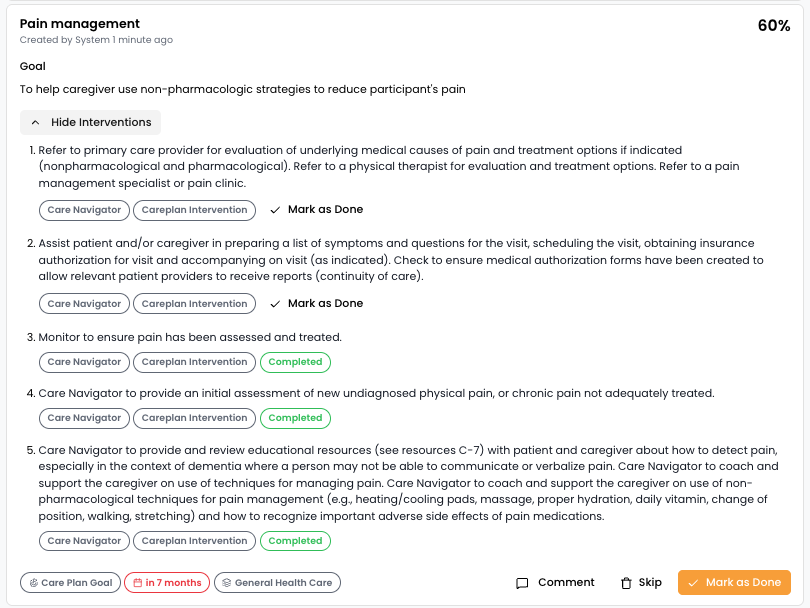
Each Care Plan item includes evidence-based interventions derived from the Johns Hopkins MIND at Home model, while also allowing Care Navigators to develop custom, caregiver-specific interventions that address unique patient and family caregiver needs. Sample: